
RESTON, Va. – Four business units of General Dynamics will be among the exhibitors at the Association of the U.S. Army (AUSA) annual meeting and exposition, scheduled for October 12-14 in Washington, D.C. Following is a list of General Dynamics products and solutions that will be displayed at the event.
GENERAL DYNAMICS LAND SYSTEMS (Booth 703)
Wolf XM30: The Wolf XM30 mechanized infantry combat vehicle is purpose-built by Land Systems as a leap-ahead replacement for the Bradley fighting vehicle, with improved survivability, lethality, mobility and fightability. Displayed in full for the first time at AUSA as a one-eighth-scale model, the Wolf XM30 implements the Army’s imperative for a Modular Open Systems Approach (MOSA) to software and hardware architectures from inception. With a born-digital design, the Wolf XM30 carries a digital thread beyond engineering and into verification, production, support and sustainment. Its mission is to deliver Soldiers to a point of positional advantage and provide decisive lethality in support of Infantry squads and Cavalry scouts.
PERCH 2.0: The Precision Effects & Reconnaissance, Canister-Housed (PERCH) technology, created in partnership with AV, has been upgraded for 2026. The common modular kit integrates onto M1A2 Abrams SEPv3 tanks and Stryker vehicles to provide beyond line of sight (BLOS) surveillance and over-the-horizon lethality via AeroVironment Switchblade SB300 loitering munitions. PERCH 2.0, debuting at AUSA, enhances survivability by enabling crews to detect and engage targets at extended ranges and to fire without having to open hatches. Reloads also are easier than the PERCH 1.0, after lessons learned at the MARS demo in 2025 at Ford Hood.
M-SHORAD, Increment 4: Land Systems’ maneuver short-range air defense (M-SHORAD), Increment 4 solution is a platform-agnostic, Self-Loading Equipment Dock (SLED)-based system of systems focused on modularity. The light, medium and heavy variants host lethality effectors and sensors mounted on various remote weapon stations. Providing defensive fires to the Army’s Mobile Brigade Combat Team (MBCT), M-SHORAD, Inc. 4 is interoperable with the service’s C2 systems and enables both independent and networked counter-drone operations.
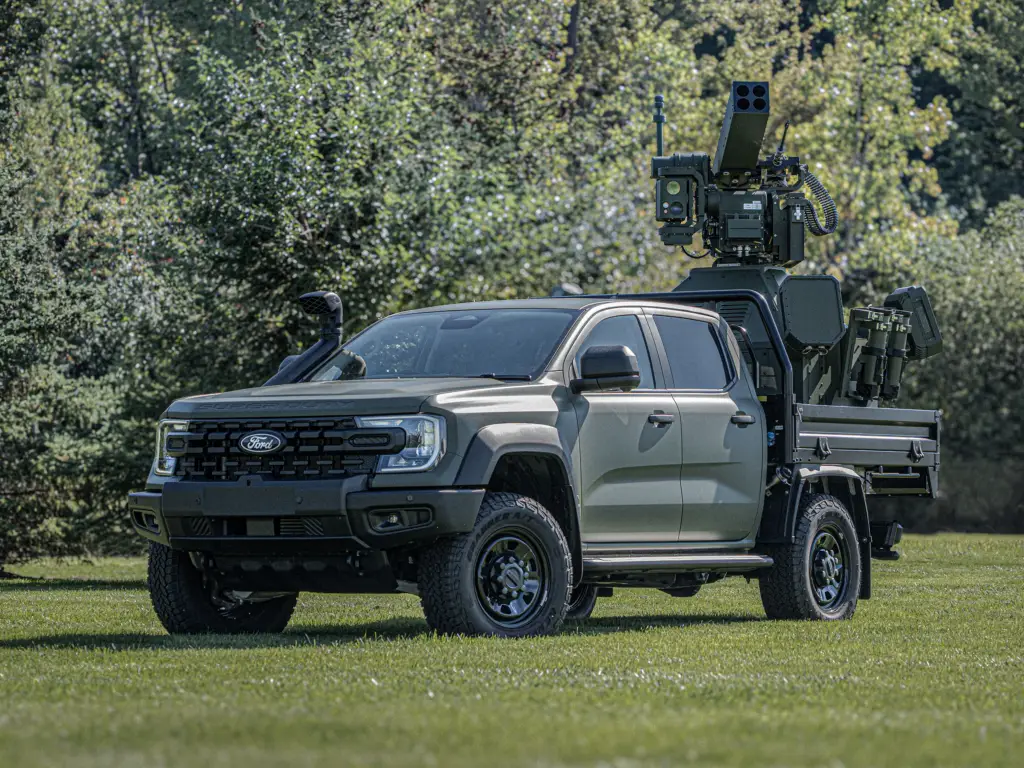
F600 Leonidas ground vehicle: Featuring Epirus’ class-leading Leonidas high-power microwave (HPM) drone-defeat technology, the F600 Leonidas is a new layer of mobile defense against unmanned aerial systems. The commercially based Ford F600 chassis has been modified by Land Systems for military missions, with increased capacity suspension, robust drivetrain and increased power generation. It integrates with Forward Area Air Defense Command and Control (FAAD C2) and can deliver effectors beyond the HPM, including traditional kinetic systems.
GENERAL DYNAMICS MISSION SYSTEMS (Booth 907)
The Secure Network & Voice Products portfolio protects classified voice, data and networks across deployed forces, command posts and enterprise networks. It includes TACLANE high-assurance, interoperable, NSA-certified network encryption; the Sectera vIPer Universal Secure Phone for end-to-end secure and nonsecure calls over VoIP and analog networks; the ProtecD@R KG-204 Multi-Platform Encryptor for high-speed classified data-at-rest protection on manned and unmanned systems; and GEM One Encryptor Manager for enterprise-wide visibility and remote management of dispersed encryptors.
TACDS is a rugged, low-SWaP-C tactical cross-domain solution that enables the secure exchange of critical information across security domains in austere and contested environments. Available in vehicle-mount and low-profile configurations, TACDS helps warfighters share the right data at the right time to support faster, more informed decisions. The demonstration will highlight support for more than a dozen RTB-compliant filters and protocols.
Multi-source and M-Code APNT solutions for ground & weapon platforms:
- MOHAWK: A resilient positioning, navigation and timing capability designed for contested environments. Featuring M-Code, advanced anti-jam performance and multi-orbit anti-jam technology, MOHAWK helps warfighters maintain trusted PNT when GPS signals are challenged, denied or degraded.
- GPS Source PNT Hub Solution: The GPS Source PNT Hub Solution (part of the U.S. Army NorthStar Program) is a modular Assured Positioning, Navigation and Timing (A-PNT) system designed to help military ground platforms operate in contested and degraded GNSS environments. Fusing GPS, GNSS, alternative navigation, IMU, wheel-speed, clock and more. GPS Source PNT Hub Solution combines resilient navigation and timing capabilities with flexible architecture and anti-jam protection, providing A-PNT to multiple simultaneous clients in an affordable package that adapts as mission requirements evolve. Built on GPS Source’s fielded PNT heritage, GPS Source PNT Hub Solution provides crews with a trusted, upgradeable solution to sustain situational awareness and operational momentum when GNSS is challenged or unavailable.
- GPS Source Assured Positioning, Navigation and Timing (PNT) solutions: Fight Tonight and Modified Reception Pattern Antenna (MRPA) Assured PNT solutions for GPS-challenged environments are based on the Joint Force-defined threat conditions and have scalable, low-cost and easy-to-install solutions for the majority of the Army tactical ground vehicle fleet.
RAMPART CMOSS Chassis: The RAMPART family of chassis is designed to enable the joint force version of a standards-based C5ISR ecosystem promoting system upgradability, modularity, reduced SWaP, improved logistics and rapid capability evolution. Supported by the broad availability of 3U OpenVPX payload capabilities, the chassis is designed to fit within the SINGCARS radio space in any vehicle or platform. It collapses several capabilities (APNT, radio, EW) into one system featuring individual slots where 3U OpenVPX processor cards can be inserted and upgraded rapidly with a variety of capabilities. The system features 100GB interconnect speed to support current and future functionality.
PhantomLink: The PhantomLink Free Space Optics system provides reliable laser communications for the tactical environment, enabling a high-bandwidth transport for modernized mobile command posts. The system combines a state-of-the-art optical terminal with a waveform-adaptable optical modem. This combination provides high link availability with maximum flexibility and interoperability. The PhantomLink system combines novel error-correction capabilities and advanced pointing, acquisition and tracking to provide a high-capacity, difficult-to-intercept communications link that is operationally effective in otherwise challenging atmospheric conditions. The system operates outside of the regulated spectrum, allowing for rapid deployment in support of military operations.
NGC2 Comms: Mission Systems’ approach to delivering Next Generation Command and Control Communications to the battlefield. Comprised of various transport layers that operate at beyond line of sight, line of sight or both, the exhibit will demonstrate how the Mounted Command and Control (MC2) Hub, the PhantomLink Free Space Optics and the Digital Radio Head can work together seamlessly to move data around the battlefields of tomorrow. Combined with the tactical-edge computing capabilities of the RAMPART CMOSS chassis, these systems offer Soldiers unparalleled command and control capabilities.
Next Gen Survival Radio: The Next Generation Combat Survival Radio (NGSR) is a U.S. Air Force-led program for the Joint Force providing line-of-sight voice and secure, over-the-horizon, two-way data communications that help combat search-and-rescue teams quickly locate, authenticate and rescue downed pilots and isolated military personnel. The radio sends encrypted formation, user identification and situation reports to provide rescue teams and aircraft operating in hazardous conditions with quick and accurate location information. The new NGSR is significantly smaller, lighter and has better power efficiency than previous combat, search and rescue (CSAR) radios.
Terrain Shaping and Advanced Breaching: This prototyping capability demonstrates Mission Systems’ work to rapidly develop and evaluate solutions that support Army terrain-shaping missions. The effort brings practical innovation to complex operational challenges, helping inform capabilities that enable commanders to shape the battlespace and preserve maneuver advantage.
Idaho Scientific: The Idaho Scientific exhibit will feature the “Spuds Attack” inline memory encryption capability demo. Visitors can experience the difference between a secured and nonsecured system while they play a spin on a retro arcade game. Idaho Scientific capabilities are built for securing mission-critical systems that operate in contested environments at the silicon level.
Modular Instrumented MDO Integrated Capability: MIMIC is a family of unattended passive or active nodes designed to mimic adversarial battlefield capabilities, enabling U.S. and coalition forces to train more realistically in a Multi-Domain Operations (MDO) environment. Designed around a core of common components and utilizing affordable, commercial-off-the-shelf, software-defined radios and operating software, each node can be configured to represent a different “personality” – e.g., RF Surveillance, HF Emitter, VHF/UHF Emitter, EO/IO Sensor and Radar Signal Simulator.
Quiver: Quiver is a multirole, software-defined radio with digital processing and RF conditioning capabilities. Its processing power, extensible input/output and precise timing can enable collaborative swarming, intelligent sensing for confident positioning, deception, and stealth search-and-strike capabilities. These capabilities are designed to help close the kill chain from remote positions while reducing risk to the warfighter. Developed by the Mission Systems Project G13 team, Quiver provides a collaborative swarm foundation for unmanned systems. It brings together software-defined communications, resilient navigation and timing, offensive electronic warfare capabilities and an interoperable autonomy framework to support operations in contested environments.
Kestrel Airspace Command and Control Suite: The Kestrel demo will showcase a unified, role-based, hardware-agnostic, software-centric solution that brings together aviation mission-planning and tactical airspace-control capabilities. Kestrel supports cloud-hosted, command-post, mobile/handheld and mounted computing environments. As a critical component of the U.S. Army’s NGC2 effort, Kestrel improves interoperability across Army, Joint and partner-nation forces.
GENERAL DYNAMICS ORDNANCE AND TACTICAL SYSTEMS (Booth 1013)
Missile subsystems: From warheads and rocket motors to missile structures, propulsion components, launch pod containers and other subsystems, GDOTS is a critical supplier across the U.S. missile acceleration enterprise, supporting a broad portfolio of major strategic and tactical missile programs. GDOTS delivers a diverse range of highly engineered subsystems and components that are integral to the performance, reliability and production of today’s most critical missile systems. With world-class expertise in the design, analysis, manufacturing and testing of missile subsystems, GDOTS brings scalable production and technical expertise to every stage of the missile lifecycle.
155mm artillery systems integrator: As a source of 155mm artillery Load, Assemble, Pack (LAP) capability, GDOTS is an end-to-end solutions provider of metal parts, high-explosive fill, Modular Artillery Charges (MACS), M119A2 Red Bags and UBX Blue Bags for the artillery enterprise, as well as a full-spectrum systems integrator. This multimission suite of 155mm artillery munitions provides long-range, high-impact support to safeguard the warfighter in demanding combat environments.
Active protection and weapon systems: Iron Fist is the trusted active protection system that utilizes independent optical sensors, tracking radar, launchers and countermeasure munitions to defeat threats at a safe distance. GDOTS also produces high-performance 20mm, 25mm and 30mm gun systems for aircraft and naval platform integration.
Counter-UAS (cUAS): A lightweight, mobile solution engineered to counter small unmanned aerial systems, the XM915 20mm Lightweight Gatling Gun delivers rapid, precise fire against emerging aerial threats. Designed to be platform-agnostic, the XM915 can integrate with a range of remote weapon stations, vehicles and other platforms, providing customers flexibility to tailor the capability to their specific mission requirements. With proven expertise in advanced weapon design and integration, the XM915 delivers a highly adaptable, dependable capability for the evolving cUAS mission.
Energetics: GDOTS’s comprehensive energetic portfolio delivers propulsion solutions for critical ammunition and defense applications. Its specialized energetic technologies, including advanced artillery charges, M31A2 and proprietary Ball Powder propellants, provide proven performance across artillery and other mission-essential systems. These integrated capabilities support the high-reliability requirements of the modern artillery enterprise and help ensure consistent effectiveness in demanding operational environments.
GENERAL DYNAMICS INFORMATION TECHNOLOGY (Booth 717)
Tactical drone fleet orchestration: GDIT harnessed AI and mission-software to provide individual warfighters voice command capabilities over their drone fleets. Once the aerial drone fleet is deployed, a commander can issue real-time verbal directions, allocating a subset of drones to one operational objective while simultaneously assigning the remainder to an alternative mission. This solution can adapt to different missions based on aircraft, payloads and targets.
Mission planning with GeoInsights: GeoInsights is a mission-planning solution that uses AI to simplify complex geospatial data for both technical and nontechnical users. Whether you’re predicting the flight path of adversaries’ drones or identifying the fastest way to move a tactical unit across rough terrain in foul weather, GeoInsights brings multiple layers of geospatial data into a single operating picture for real-time command-and-control decisions.
Everest zero trust solution portfolio: The escalating sophistication of AI-driven cyber threats continues to intensify risks to government IT systems and critical infrastructure. GDIT’s modular zero trust solutions are the first and only to successfully complete a government “red team” cyber assessment for upgrading existing IT systems, enhancing security and reducing implementation costs. GDIT also is expanding its solution modules to cover cybersecurity for operational technology.
AI-powered aerial threat detection with DOGMA: Drones are increasingly challenging the security of U.S. military operations and homeland defense. GDIT’s DOGMA solution delivers advanced AI-driven threat detection, dramatically accelerating the response time for warfighters to counter threats from minutes to milliseconds. By integrating and synthesizing data from diverse sources into a unified operational display, DOGMA provides comprehensive situational awareness of all aerial threats across the battlespace.
Follow us on X during the show:
- General Dynamics Land Systems: @GD_LandSystems
- General Dynamics Mission Systems: @GDMS and @GDMS_C
- General Dynamics Ordnance and Tactical Systems: @GD_OTS
- General Dynamics Information Technology: @GDIT
TACLANE, Sectéra, vIPer, ProtecD@R, GEM, TACDS, Quiver and Ball Powder are registered trademarks of General Dynamics, its business units or its affiliates.
About General Dynamics
Headquartered in Reston, Virginia, General Dynamics (NYSE:GD) is a global aerospace and defense company offering a broad portfolio of products and services in business aviation; ship construction and repair; land combat vehicles, weapons systems and munitions; and technology products and services. General Dynamics employs more than 110,000 people worldwide and generated $52.6 billion in revenue in 2025. More information is available at www.gd.com.